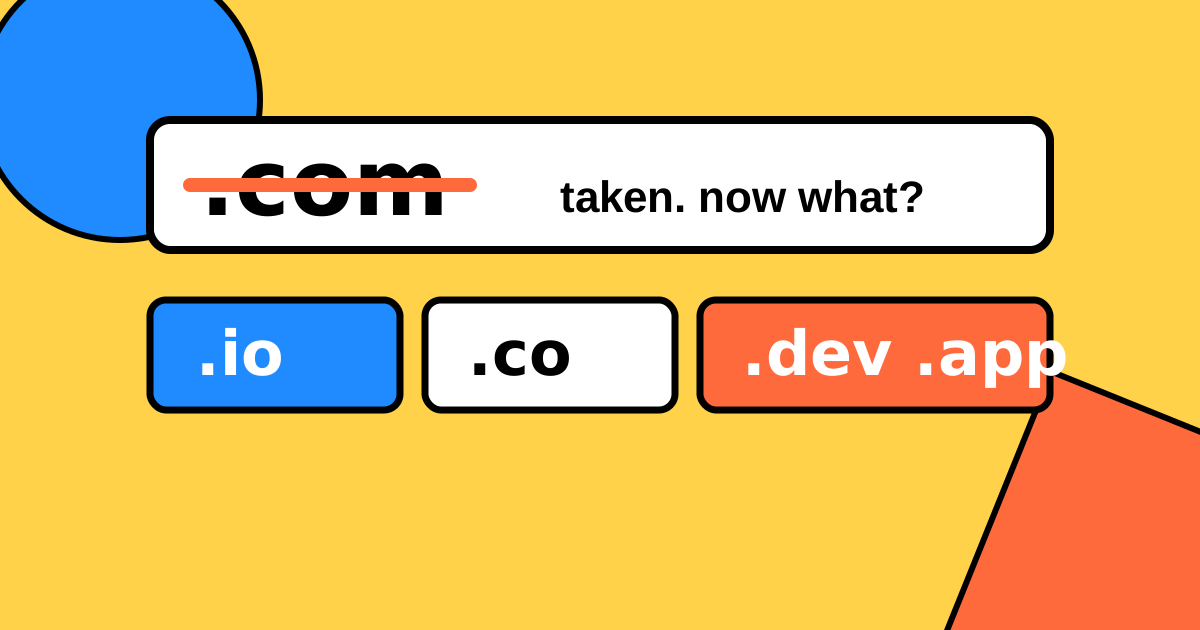
Every naming session reaches the same moment: the name is right, everyone likes it, and the .com was registered in 2004 by someone who has never used it. The instinct is to mangle the name — add get, add try, add a hyphen — but that is almost always the worse option. A clean name on a different extension beats a compromised name on .com, and has done for years.
The question is which extension. They are not interchangeable, and the differences are more practical than aesthetic.
First, Is .com Still Worth the Fight?
Yes, but less than people think, and for a narrower reason than people give.
The honest case for .com is not search ranking — Google has been explicit for years that it does not favour one generic extension over another. The real case is type-in behaviour: a meaningful share of people hear a name, assume .com, and type it. If your .com belongs to someone else, some fraction of your audience lands on their site.
That matters enormously for a consumer brand people hear about by word of mouth, and much less for a developer tool discovered through a link. Weigh it accordingly rather than treating .com as a universal requirement.
The Serious Alternatives
.io — the default for tech, at a price
Still the strongest signal for developer tools and startups, with an established convention behind it. It is expensive relative to .com and renewals do not get cheaper.
The thing worth knowing: .io is the country code for the British Indian Ocean Territory, and its long-term administration has been subject to political change. The registry has signalled continuity, and a large amount of infrastructure depends on it, but it is a country-code domain rather than a generic one, and that is a real if low-probability risk to hold in mind for a decades-long brand.
.co — the closest thing to a .com substitute
Short, pronounceable, and reads as an abbreviation of company. Genuinely the best general-purpose fallback, and it does not mark you as any particular kind of business.
The cost is real, though: you will lose some traffic to the .com through mistyping, and you will spend a certain amount of your life saying dot see oh, not dot com on phone calls.
.dev and .app — small but meaningful advantages
Both are on the HSTS preload list, which means browsers require HTTPS for every site on them. You cannot serve an insecure page. For a technical audience that is a genuine trust signal rather than a marketing one.
.dev reads as a developer tool or a personal engineering site. .app reads as a consumer application and is a clean fit for a mobile product.
.ai — expensive, and priced on a trend
Now effectively the default badge for AI products, with renewal pricing to match. It signals clearly and it is genuinely hard to substitute if your product is AI-native. We looked at the economics of this in more depth in our guide to .ai domains.
.xyz, .site, .online — cheap, and it shows
These are inexpensive because they are abundant, and abundance attracts spam. Several have been heavily used by low-quality operations, which means some corporate mail filters treat them with suspicion and some users simply do not trust them.
There are prominent exceptions — a well-known holding company uses .xyz — but they succeed despite the extension, on the strength of a brand nobody needed convincing about. If you are building trust from zero, you are starting with a small deficit.
Country codes used as words
Extensions like .me, .sh, .to, .fm and .gg get used as part of the name rather than as a nationality. This can be genuinely elegant when the word falls naturally across the dot.
Two practical cautions. Some country codes require a local presence or have restrictive registration rules, so check before you fall in love. And email on an unusual extension gets flagged as suspicious more often than you would like.
What Actually Matters More Than the Extension
In practice, these three things affect you more day to day than which suffix you picked:
- Can you say it once and be understood? A name that needs spelling out costs you on every phone call, podcast and conference introduction, forever.
- Does email work reliably? Deliverability varies by extension reputation. If mail is core to your business, this is worth more than aesthetics.
- Is the renewal price stable? Some extensions carry premium renewals or have raised prices substantially. Check the renewal rate, not the first-year promotional rate — that gap is where the unpleasant surprises live.
Register the exact-match domain on a second extension if the budget allows, and redirect it. It costs the price of a coffee per year and closes the most common typo path to a competitor or a parked page.
What to Avoid
- Hyphens. Impossible to communicate verbally, routinely forgotten, and long associated with the cheaper end of the web.
- Prefixes like get, try, use, join. They signal that the real name was taken, and they double the length of everything you print.
- Deliberate misspellings. You will spend the rest of the brand's life correcting people, and the correctly spelled version will collect the traffic you earned.
- Numbers where a word should be. Is it 4 or four? Nobody knows, including your audience.
A Workable Order of Operations
- Shortlist names that pass the say-it-out-loud test.
- Run the whole list through the bulk checker to see which names are clean across extensions and social platforms at once — comparing side by side beats checking one at a time.
- Prefer a clean name on .co, .io, .dev or .app over a mangled name on .com.
- Check the renewal price, not the first-year price.
- Before committing, confirm the name does not collide with an existing trademark — available is not the same as safe.
The extension is a smaller decision than the naming panic makes it feel. Plenty of substantial companies run on .co, .io and .app without anyone noticing. Almost nobody succeeds with a hyphenated .com they have to spell out every time they say it.
Share this article
Want to secure these usernames?
Check Availability