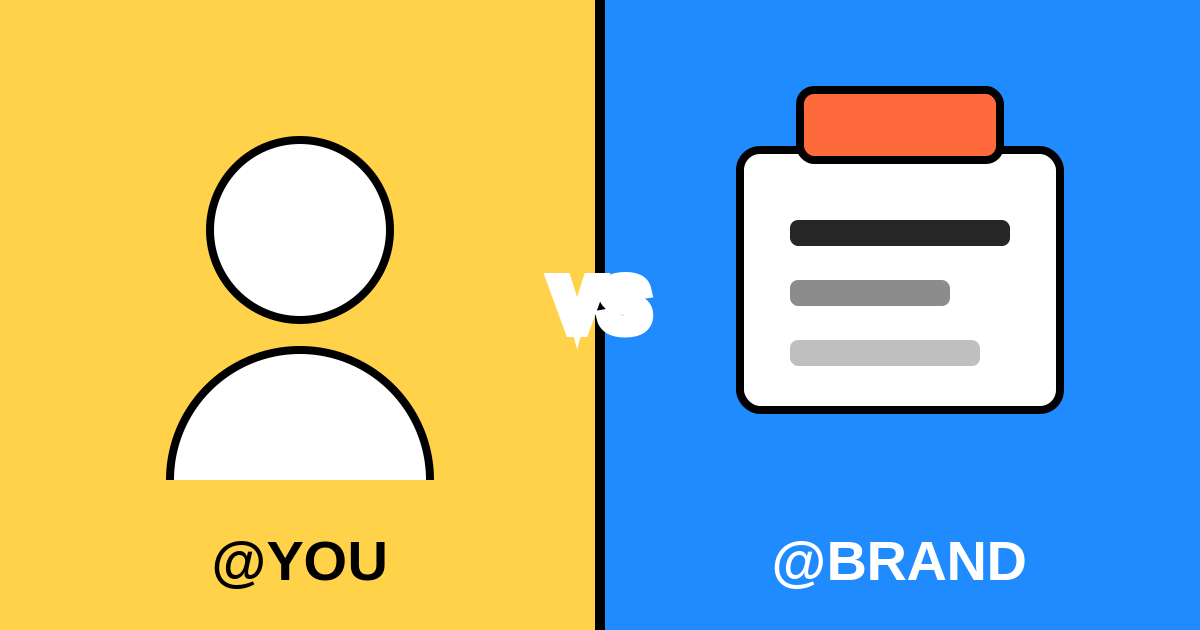
The age-old dilemma: @JohnDoe or @DoeDesignCo? People agonize over this because it feels permanent — and because both camps have loud success stories. The honest answer: it depends on your exit strategy, your appetite for being the face, and how you want to scale.
The Case for Your Own Name
- It survives every pivot. Career change, niche change, new product — your name comes with you. No rebrand required.
- Trust compounds faster. People connect with people. A personal account posting the same content as a brand account almost always grows faster early on.
- It's usually more available. Full names and name-plus-craft combinations ("SarahChenDesign") are claimable far more often than dictionary-word brands.
The costs: you can't easily sell "you", you can't step back without the content stopping, and scaling means your team ghostwrites as you — which audiences increasingly notice.
The Case for a Business Name
- It's a sellable asset. Acquirers buy brands, not faces. If the goal is to exit someday, build equity in a name that isn't on your passport.
- It scales past one person. Hiring writers, support, and creators under a brand feels natural; under a personal account it feels like a bait-and-switch.
- It gives you privacy. The brand takes the spotlight; you keep a personal life.
The costs: slower early trust, more marketing effort to give it personality, and a harder naming problem — good brand names are scarce, and the matching handles and domain are scarcer.
A Decision Framework That Settles It
Answer these honestly:
- Would you sell it in ten years? Yes → business name. It's brutal to sell a company named after yourself.
- Is the business YOU (consulting, coaching, art, writing)? Yes → personal name. Hiding the person behind a brand just adds friction.
- Will it ever run without you creating daily? Yes → business name, or you'll be chained to the content calendar forever.
- Still torn? → Do both, deliberately (below).
What Each Choice Means for Handles and Domains
The strategic question gets most of the attention, but the practical one often decides it: which name can you actually get?
- Common personal names are crowded. If your name is shared by thousands of people, the plain version is gone on every major platform. The usual fixes are a middle initial, your craft ("AnnaReedWrites"), or a short prefix used consistently everywhere.
- Unusual personal names are an asset. If a search for your name mostly returns you, that is a head start no invented brand can match. Claim it everywhere now, even if you end up leading with a business name.
- Descriptive business names are nearly always taken. "BestWebDesign" was registered long ago. Invented or combined words are far more likely to be free as a handle and a .com at the same time.
- Consistency beats perfection. The same slightly longer name on every platform is better than the ideal name on one and three different workarounds on the rest.
The Paperwork Side
The two paths also differ once money is involved. Trading under your own legal name is usually the simplest setup: in many places you can invoice as yourself without registering a separate business name. Trading under an invented name typically means registering it with the relevant authority, and the rules differ by country and sometimes by state, so check what applies where you live.
Trademarks work differently too. A distinctive invented brand name is generally the easiest kind of name to register and defend. A personal name can be harder to protect, particularly a common surname, because many other people have a legitimate reason to use it. If you expect the name itself to become valuable, that tilts the decision toward a brand. Our guide on why available does not always mean safe explains how to check a candidate before you commit.
If You Change Your Mind Later
This decision is less permanent than it feels. Plenty of businesses started under a founder's name and moved to a brand once there was a team, and plenty of brands became personal accounts when the founder turned out to be the draw. What makes the switch painful is not the change itself but doing it without preparation.
Two habits keep the door open. First, register the name you are not using, so it is still yours when you want it. Second, mention the other name occasionally, in a bio line or a signature, so your audience already associates the two. When the time comes, a planned move keeps most of your followers; our walkthrough on rebranding a username without losing your audience covers the order to do it in.
The Hybrid Play (What Most Pros Actually Do)
Secure both names now, then lead with one. Personal account drives attention; business account holds the product. Your face builds the trust, the brand collects the equity. The two link to each other in every bio.
This only works if both names are actually available where you need them. Check your name and your brand candidates across platforms and domains in one search with our availability checker — and if the brand name is proving hard to find, our AI name generator is built exactly for that hunt.
There is no universally right answer — but there is a right answer for your five-year plan. Decide on the destination first, and the name follows.
Share this article